The post ATT Regional Actors Handbook first appeared on Control Arms.
]]>The Regional Actors project – which was initiated with the generous support of Germany – takes stock of the work of Regional Organizations to better understand how they contribute to ATT promotion, universalization, and implementation efforts and to identify opportunities for further engagement of Regional Organizations in supporting the ATT.
It is intended as a guide for ATT States Parties to better understand what type of ATT assistance is available within their respective regions. As such the handbook gives a snapshot of the diversity of instruments, policies, tools and activities developed and undertaken in this area by a variety of regional bodies, with a specific focus on the ATT.
It also highlights several areas in which the Regional Organization experience can provide guidance and lessons learned for ATT stakeholders.
Part I – Profiles of Regional Organizations
Using the Small Arms Survey Handbook on “Regional Organizations and the UN Programme of Action on Small Arms (PoA)” as a model, the first part of the ATT Regional Actors Handbook showcases the profiles of 27 regional organizations. These organizations were selected for inclusion in the Handbook based on their engagement with the ATT or related instruments and programs.
Each profile is comprised of two sections:
1. Organization Description
Where applicable, the profiles also include information on regional instruments which share linkages or complementarities with the ATT. This analysis seeks to foster a better understanding of the key synergies and complementarities between the ATT and these instruments, in order to better illustrate the relevance of the broad range of activities and efforts by Regional Organizations to the universalization and implementation of the ATT.
2. Account of ATT-related activities
In this section, the research team looked at 2 key areas: 1) ATT Support and 2) Establishing Transfer Controls.
Given the broad range of assistance covered in this subsection, activities are organized in four types of initiatives 1) National Control System, 2) Legal Assistance, 3) Diversion Prevention and 4) Gender and GBV.
Part II – Key Findings and Recommendations
This section provides a set of general findings and specific recommendations for Regional Organizations, for ATT States Parties and other stakeholders. In particular, the recommendations highlight opportunities through which Regional Organizations could further their engagement in the ATT as well as ways in which member states can partner with Regional Organizations on ATT-related projects.
Annexes
The Handbook also includes three Annexes:
- Annex I provides a snapshot of the information provided in the Regional Organization profiles
- Annex II offers a survey of regional instruments and agreements included in the profiles outlined in Part I with a particular focus on their scope and reporting requirements.

LAUNCH EVENT:
Exploring the Critical Role of Regional Actors in ATT Universalization and Implementation
The post ATT Regional Actors Handbook first appeared on Control Arms.
]]>The post NEW RELEASE: ATT Gender Action Plan Project first appeared on Control Arms.
]]>
The primary goal of the methodology and the survey, which were launched at CPS8, is to have some accountability and ways to measure how States and other stakeholders are doing in terms of implementing CSP5 decisions and recommendations.
The methodology provides a comprehensive view of how gender and GBV should be factored in within the ATT and related processes. The ATT stakeholder survey is intended for both State Parties and signatories and responses will provide valuable information on the implementation of CSP5 gender and GBV related commitments that may not be publicly available.
The survey is also expected to fill existing gaps in knowledge, information sharing, and reporting. To complement the collective methodology, Control Arms is in the process of developing short case studies on a few States Parties that demonstrate exceptional work in the gender and GBV areas. Highlighting these positive examples can serve as guidance, at the regional and international levels, for States that are at different stages with regard to the implementation of gender and GBV commitments in the context of the ATT, and more broadly to their gender evolution.
The post NEW RELEASE: ATT Gender Action Plan Project first appeared on Control Arms.
]]>
This Arms Trade Treaty Regional Actor Study highlights key findings, provides lessons learned and sets out recommendations on how ATT stakeholders can continue to foster engagement by regional organizations in ATT universalization and implementation efforts.
The post Publication: Arms Trade Treaty Regional Actor Study first appeared on Control Arms.
]]>The post Interpreting the Arms Trade Treaty: International Human Rights Law and Gender-Based Violence in Article 7 Risk Assessments first appeared on Control Arms.
]]>The Arms Trade Treaty (ATT) aims to reduce human suffering; prevent the illicit trade in arms; contribute to international and regional peace, security, and stability; and promote transparency and cooperation among States Parties. It requires States Parties to conduct good-faith assessments of the likely end use of arms transfers and the effects of those transfers in destination countries and obligates States Parties to refuse authorization for certain arms transfers.
Article 7(1) of the ATT requires an exporting State Party, when determining whether to allow an arms export, to assess the potential that the arms could be used to commit or facilitate a serious violation of international human rights law, among other things, as well as the potential that the arms would contribute to or undermine peace and security. Article 7(4) requires States Parties to take into account the potential for arms to be used to commit or facilitate serious acts of gender-based violence (GBV) or violence against women and children when conducting this risk assessment.
Article 7(2) requires that once a State Party determines that there is a risk of an Article 7(1) harm, the State Party must then consider if there are measures that could be established to mitigate that risk. Under Article 7(3), after a State Party considers mitigating measures, it must refuse to authorize an export if there remains an overriding risk of an Article 7(1) harm. The Article 7 risk assessment takes place only after the State Party has determined that the export is not absolutely prohibited under Article 6 (which prohibits exports when the State Party knows the arms would be used in the commission of genocide or crimes against humanity, among other things).
States Parties must consider gender and risks of GBV when they assess: the risk of serious human rights violations (or other Article 7(1)(b) harms); the effects on peace and security; and the availability of prospective mitigating measures. All of these feed into the final determination of whether an overriding risk exists.
This paper provides interpretive guidance on key terms that appear in Article 7, namely: “serious violation of international human rights law”; “serious acts of gender-based violence”; “commit or facilitate”; “peace and security”; “contribute to or undermine”; and “overriding risk.” It examines how gender and risks of GBV are relevant to each part of the Article 7 risk assessment, particularly with respect to serious violations of international human rights law.
This paper complements Control Arms’ Practical Guide on how to use the Arms Trade Treaty to address Gender-Based Violence, which provides guidance on the legal and policy frameworks relevant to GBV and outlines a variety of indicators and other measures export authorities can use to identify and understand risks of GBV in different contexts.
The post Interpreting the Arms Trade Treaty: International Human Rights Law and Gender-Based Violence in Article 7 Risk Assessments first appeared on Control Arms.
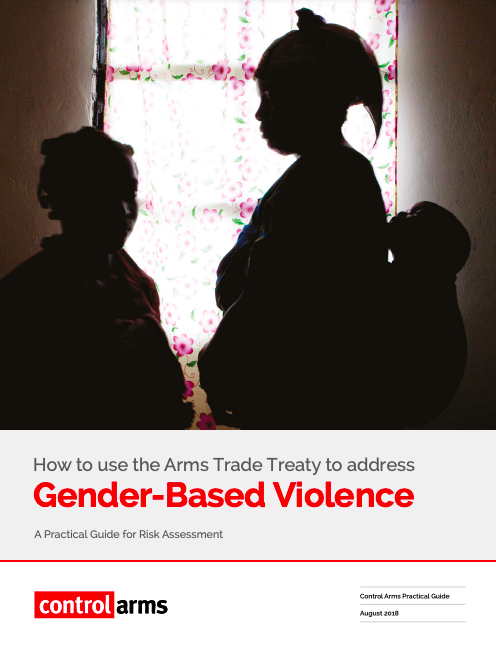
]]>The post How to use the Arms Trade Treaty to address Gender-Based Violence: A Practical Guide for Risk Assessment first appeared on Control Arms.
]]>All States Parties to the ATT, exporters and importers alike, need to understand when and how to assess the prevalence of arms-related GBV and states’ responses to it, to effectively incorporate GBV-related ATT obligations into export assessments.
This practical guide offers advice to practitioners and state representatives engaged in export assessments required under the ATT in relation to GBV. It offers useful indicators, guidelines and emerging principles to help develop the requisite expertise and experience to meaningfully incorporate GBV into export assessments.
It does not intend to be exhaustive, conclusive nor provide guidance on whether a certain situation or context could or would require a prohibition under Article 6 or a denial of authorization pursuant to Article 7. Instead, building on previous publications that identify indicators of GBV, sources of data and suggested questions to ask during export assessments,1 it provides an implementing framework within which licensing officials can consider their GBV-related obligations in assessing arms transfers to ensure they comply with the ATT and promote its goals.
The post How to use the Arms Trade Treaty to address Gender-Based Violence: A Practical Guide for Risk Assessment first appeared on Control Arms.
]]>