The post Ammunition Controls: Outcomes of the June 2025 Global Framework Meeting first appeared on Control Arms.
]]>Background: A New Global Framework for Ammunition
While diverted ammunition fueled conflict, crime, and terrorism, and as accidental explosions at ammunition depots claimed thousands of lives worldwide, ammunition control remained a glaring gap in international arms controls. The adoption by the UN General Assembly of the Global Framework for Through-life Conventional Ammunition Management (GFA) – a set of political commitments which aim to improve the safe, secure, and accountable management of ammunition worldwide – has finally closed this long-standing policy gap.
This new framework has emerged after years of debate, as ammunition has long been excluded from earlier instruments such as the UN Programme of Action on Small Arms. That gap led the UN General Assembly to launch a special process in 2021 to develop a new set of political commitments focused on through-life ammunition management.
The GFA, whice covhers all types of conventional ammunition, contains 15 objectives and 85 measures which seek to address the full “through-life” span of ammunition, from production and stockpiling through transfer, use, and disposal. It comprehensively tackles both safety (preventing deadly unplanned explosions in depots) and security (preventing diversion of ammunition to illicit markets), with the goal of saving lives and enhancing global peace and security.
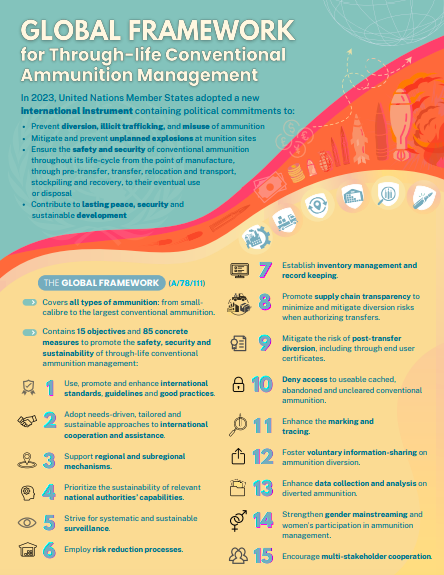
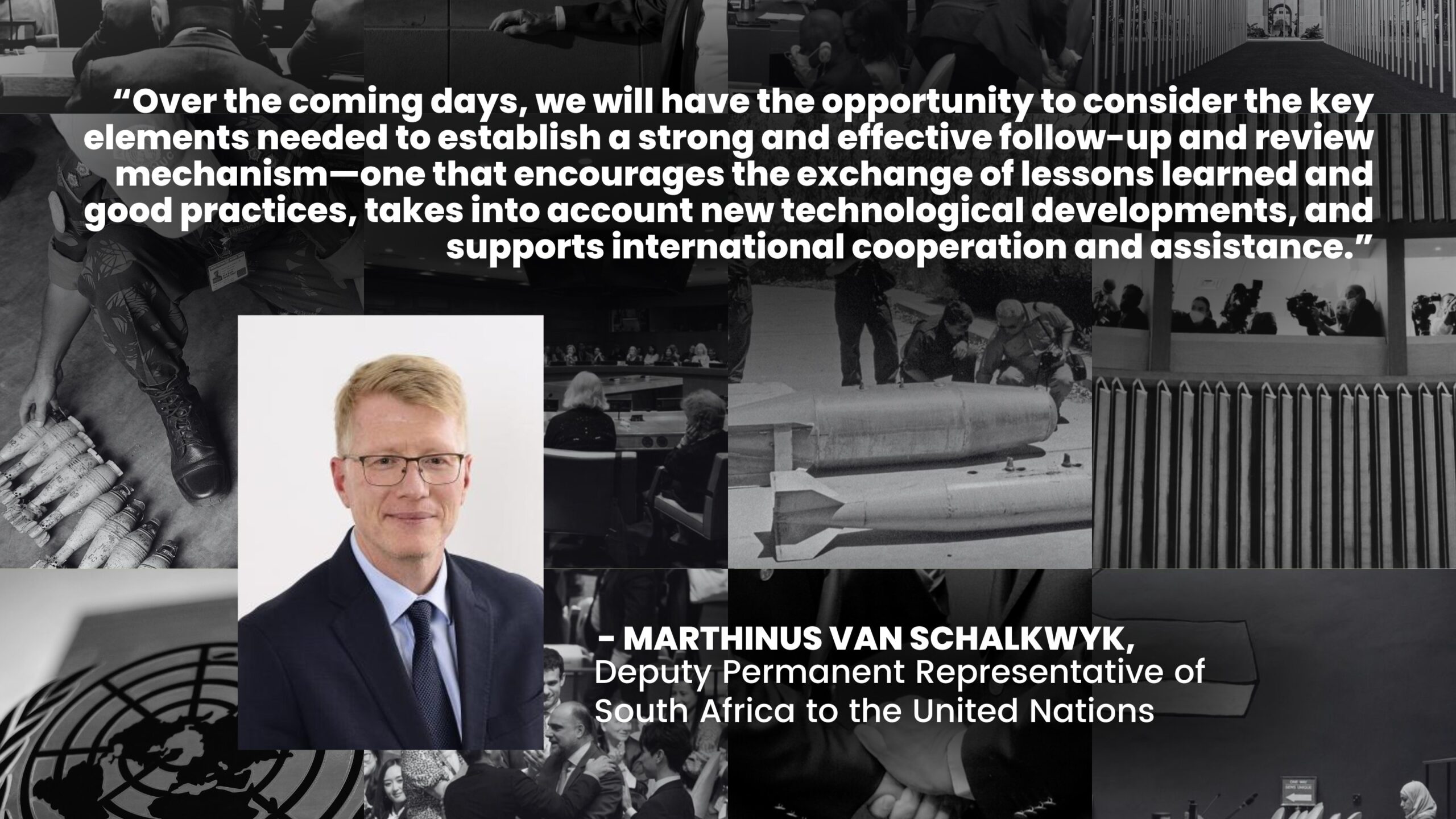
Photo Credit: UNODA
The June 2025 Preparatory Meeting and Its Focus
A month ago, delegates and representatives of international organizations and civil society gathered at the United Nations in New York for the first Preparatory Meeting of States on the GFA. The broad participation in this inaugural meeting underscored the global support and momentum behind the initiative.
“We are fortunate to be supported by a wide range of actors… Their expertise and partnership are vital in advancing the Framework,” noted Ambassador Marthinus van Schalkwyk of South Africa, the Chair of the preparatory meeting.
The primary goal of this meeting was to lay the groundwork for the GFA’s implementation and the inaugural Meeting of States planned for 2027. As such, much of the agenda was dedicated to procedural and organizational matters – agreeing on how future meetings will function, how countries will report on their progress, and how to involve various stakeholders.
Notably, States agreed on a periodic review mechanism: they recommended holding a high-level Meeting of States every six years to review implementation of the GFA, with the first such meeting set for 2027. To ensure continuous momentum in between these major conferences, the 2025 Preparatory Meeting also proposed convening two technical expert meetings in the intersessional period after 2027 (each five days long) to delve into practical themes such as stockpile safety, marking and tracing technologies, and ammunition disposal methods.
,States also endorsed a voluntary national reporting template which will be used to share implementation progress, challenges, and needs under each of the GFA’s objectives. States are encouraged to submit an initial baseline report in 2026 – outlining steps they have taken so far to implement the GFA measures – which will form the basis for the discussions at the 2027 review meeting. Afterwards, GFA reports—submitted on a voluntary basis—will follow a biennial reporting cycle.
Participants also discussed substantive issues such as international cooperation and assistance for ammunition management, and they highlighted cross-cutting themes, for example, the need to integrate a gender perspective in implementing the GFA. Notably, several delegations and civil society speakers stressed the importance of women’s full, equal, and meaningful participation in ammunition management efforts, aligning with the GFA’s gender-mainstreaming objective.
Synergies with the Arms Trade Treaty
With shared objectives and complementary provisions, the implementation of the GFA is also expected to strengthen the implementation of the Arms Trade Treaty (ATT). While the GFA sets out a range of political commitments, the ATT is a legally binding treaty that regulates the international trade in conventional arms and includes explicit provisions on ammunition transfers. As set out in Article 3, the ATT’s prohibitions under Article 6 and export risk assessments under Article 7 apply to ammunition. In addition, States Parties are required to establish and maintain a national control system to regulate the export of ammunition or munitions fired, launched, or delivered by any of the covered weapons. However, ammunition is notably absent from Article 11 of the ATT, which addresses the prevention of diversion. Similarly, the ATT’s provisions on weapons management from a safety perspective are not as detailed or robust as those found in other conventional arms control frameworks.
The Global Framework addresses these gaps by taking a more comprehensive, “through lifecycle approach” to ammunition controls. It outlines specific measures to improve supply chain transparency and end-user controls (Objectives 8 and 9) to mitigate diversion risks, and it provides guidance on safe stockpiling, inventory management, and disposal of surplus or obsolete ammunition to reduce the risk of accidents or misuse.
As preparations for the Eleventh Conference of States Parties to the ATT (25–29 August in Geneva, Switzerland) begin, the Global Framework offers a new reference point for States seeking to strengthen national control systems and improve diversion prevention measures. In this context, the ATT Voluntary Trust Fund can serve as a practical mechanism to support activities that align with the Framework’s objectives, promoting greater coherence across conventional arms control instruments.
The post Ammunition Controls: Outcomes of the June 2025 Global Framework Meeting first appeared on Control Arms.
]]> 2. The Arms Trade Treaty is the first legally-binding instrument to recognise the link between gender-based violence and the international arms trade. Under the ATT, it is illegal to transfer weapons if there is a substantive risk that the weapons will be used to facilitate GBV. Find out how states can implement this criterion with our Practical Guide on how to use the ATT to address GBV.
 3. Conflict and armed violence affects men and women in different ways. While men are both perpetrators and the primary victims of armed violence, women are more likely to be displaced, be the victims of sexual violence, and have their lives negatively impacted by exacerbated social, economic and political inequalities.
 4. According to the Women’s International League for Peace & Freedom, gender-based violence is violence linked to to the gendered identity of being a woman, man, intersex, transsexual, or transgendered, and it is the most prevalent form of violence in the world.
There are 4 types: Sexual violence, physical violence, emotional & psychological violence, and socioeconomic violence. Read more here: https://s3.amazonaws.com/unoda-web/wp-content/uploads/2018/07/Publication_Gender-based-violence-and-the-ATT_brief.pdf
4. According to the Women’s International League for Peace & Freedom, gender-based violence is violence linked to to the gendered identity of being a woman, man, intersex, transsexual, or transgendered, and it is the most prevalent form of violence in the world.
There are 4 types: Sexual violence, physical violence, emotional & psychological violence, and socioeconomic violence. Read more here: https://s3.amazonaws.com/unoda-web/wp-content/uploads/2018/07/Publication_Gender-based-violence-and-the-ATT_brief.pdf
 5. Equal representation at peace and disarmament negotiations are crucial to building and maintaining lasting peace. For too long negative masculinity norms of power and dominance have dictated these forums that inevitably perpetuate war and violence.
As Reaching Critical Will explains, “There is a stark disparity in the level and volume of participation of women, men, and others in disarmament and arms control discussions, negotiations, and processes. Recent research has shown that at any given intergovernmental meeting on disarmament, only about one quarter of participants are likely to be women and almost half of all delegations are likely to be composed entirely of men. This underrepresentation is fuelled in part by the tendency to treat women as vulnerable victims, usually grouped together with children and the elderly—this framing reinforces persistent constructions of women as the “weaker sex” in need of protection by “powerful” men and enable women’s continued exclusion from authoritative social and political roles. Meanwhile, the framing of all military-aged men as “potential” or actual militants entrenches a tendency to support “violent masculinities”—a social construction in which masculinity is linked with preparedness to use military action and to wield weapons.”6. The war in Yemen, fuelled by illegal and immoral arms transfers, has had a devastating toll on women & children. Damage to critical infrastrastructure and social services as well as lack of resources has left millions malnourished, with mothers left to fend on their own. According to ReliefWeb, “In 2016 nearly 220,000 pregnant and breastfeeding women were admitted to health facilities in Yemen with acute malnutrition. As the response expanded, the figure surged to nearly 410,000 during 2018 – an increase of 87%. Malnourished pregnant women run an increased risk of miscarriages and the anguish they cause, along with anemia and even dying during childbirth.”
 7. A small arm is used in almost half of all violent deaths globally and in approximately one-third of all femicides. In countries with the highest rates of femicide, more than half of these killings are perpetrated with small arms. Find out more facts and figures on gender, GBV and the Arms Trade Treaty as well as ideas for action in our factsheet produced in collaboration with …:https://s3.eu-west-2.amazonaws.com/igc-production/pJkGV9e72rfkMY6BAr5_caG0edLlNqTR.pdf
 8. Women and children in South Sudan suffer from some of the most extreme gender-based violence in the world. UNICEF states that “GBV was already rife prior to the conflict, and is now nearing epidemic proportions.”
“Women and girls associated with armed groups who have escaped, report rape and other physical abuse. Decades of conflict have created a highly militarised environment and a culture of violence. This allows perpetrators of GBV to operate with greater im
punity. Survivors may fear stigma or reprisals, hence do not report.”
8. Women and children in South Sudan suffer from some of the most extreme gender-based violence in the world. UNICEF states that “GBV was already rife prior to the conflict, and is now nearing epidemic proportions.”
“Women and girls associated with armed groups who have escaped, report rape and other physical abuse. Decades of conflict have created a highly militarised environment and a culture of violence. This allows perpetrators of GBV to operate with greater im
punity. Survivors may fear stigma or reprisals, hence do not report.”
 9. Data collection on violence against women is sparse. More resources need to be invested into producing gender-disaggregated data to better help us understand the problem and how to address it.
 10. Gender-based violence has been used as a weapon of war for millennia and should be treated as such. Serious acts of GBV are in violation of both International Humanitarian Law and International Human Rights Law, and constitutes a war crime.
It’s time to use the Arms Trade Treaty’s Gender-Based Violence provisions to protect women and children around the world.
10. Gender-based violence has been used as a weapon of war for millennia and should be treated as such. Serious acts of GBV are in violation of both International Humanitarian Law and International Human Rights Law, and constitutes a war crime.
It’s time to use the Arms Trade Treaty’s Gender-Based Violence provisions to protect women and children around the world.The post 10 Facts on Gender & Gender-Based Violence ahead of CSP5 first appeared on Control Arms.
]]>The post UN Security Council high-level debate sheds light on the African continent’s future first appeared on Control Arms.
]]>Following an historic peace accord between longtime enemies Ethiopia and Eritrea, UN Secretary General Antonio Guterres said there is a ‘wind of hope blowing in the Horn of Africa’, and that the detente has a ‘very important meaning in a world where we see, unfortunately, so many conflicts multiplying, and lasting forever’.

Ethiopia’s Prime Minister Abiy Ahmed and Eritrean President Isaias Afwerki sign a peace agreement in Saudi Arabia on Sunday. Photo credit: standardmedia.co.ke
Striking a similar tone, some states cited recent peace agreements in the Central African Republic (CAR) and South Sudan as important achievements in diplomacy and peacebuilding that may be used as models for ongoing conflicts in the Democratic Republic of Congo (DRC) or Mali. These successes follow a string of encouraging developments over the past three decades including peaceful outcomes in South Africa, Mozambique, Madagascar, and Sierra Leone.
Yet these developments are few and far between. After a period of relatively successful conflict resolution, growth and prosperity, many are of the view that the continent is now slipping in the opposite direction. Reflective of our times, several statements during the meeting illustrated a dark outlook for a continent rife with new and old conflict, trapped in a perpetual state of violence, instability, and limited growth, fueled by arms flows.
Vasu Gounden, Founder and Executive Director of the African Centre for the Constructive Resolution of Disputes (ACCORD), offered a poignant and thorough examination of the current state of affairs in Africa, citing deep structural challenges where skills development and employment creation have not been successful due to the lack of a ‘fundamental transformation in the structure of Africa’s economies for decades’. While most African countries remain agricultural economies with little to no shift towards an industrial or services economy, he explained, the population is growing exponentially, rapidly urbanising into ‘unplanned cities that offer no prospect of proper housing, health care, education, sanitation, water, etc.’ The result? A tinderbox ripe for ignition as the unrestrained flow of weapons completes the equation.

Vasu Gounden, Founder and Executive Director of the African Centre for the Constructive Resolution of Disputes (ACCORD). Source: UN Web TV
The Council’s 15 members unanimously adopted a resolution that outlines steps towards ending conflict in Africa and welcoming the AU’s “Silencing the Guns” initiative. The majority of governments acknowledged the persistent obstacles of poor governance, arms trafficking, corruption, or unemployment towards a peaceful and prosperous African continent. And like most UN meetings, they also offered a path forward, indicating the need for more resources, international assistance, cooperation, and accession to & compliance with arms control instruments such as the Arms Trade Treaty (ATT) and the UN Programme of Action on Small Arms and Light Weapons. Yet, as Mr. Gounden inquired, what will Member States do beyond passing this resolution? As Africa approaches this turning point, how will governments stem the flow of illicit weapons and confront the structural and systemic challenges that have stagnated much of the continent and present greater issues down the road?
For one, states must summon the political will necessary to meaningfully engage with regional and international instruments designed to confront these types of issues. Perhaps the most pressing and consequential would be to adhere to and effectively implement the ATT, as it provides a clear framework which member states can use to strengthen national and regional arms control initiatives and ultimately, reduce the proliferation of arms and ammunition on throughout the continent. As of now, 25 of the 54 African countries have joined the Treaty, and each is at different baselines in their implementation of the Treaty’s provisions. The more states join and introduce effective import and export controls, the easier it will be to harmonize arms control and diversion prevention measures across the continent. This will allow governments to exert greater authority over the destination and use of these weapons, helping to prevent lighting the unstable ‘tinderbox’ environment outlined above.
History has taught us that cooperation and healthy competition between states leads to growth, prosperity, peace and security. This insight is wielded through the strategic framework of the African Union’s Agenda 2063, which seeks to build on and ‘accelerate the implementation of past and existing continental initiatives for growth and sustainable development’, including the Lagos Plan of Action, the Abuja Treaty, the New partnership for Africa’s Development, and the “Silencing the Guns” campaign. Only through good-faith commitment to these ambitious but necessary mechanisms will African states be able to begin dismantling the systemic and structural barriers that impede the continent from reaching its full potential.
The post UN Security Council high-level debate sheds light on the African continent’s future first appeared on Control Arms.
]]>The post 10 Reasons to Tackle Diversion at the CSP 2018 first appeared on Control Arms.
]]>Click each image to send a tweet and help #StopDiversion

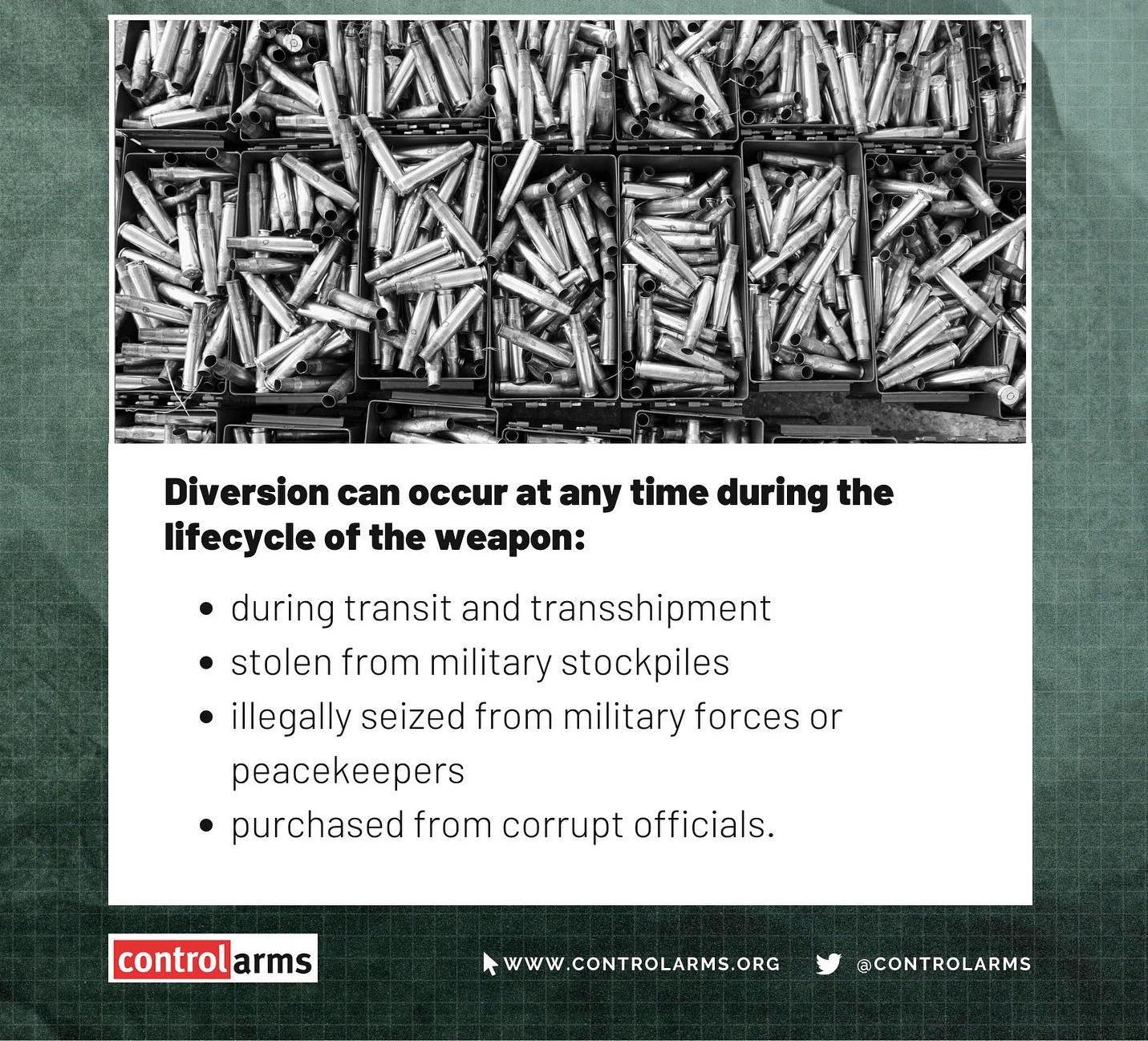
1. Diversion can occur at any time during the lifecycle of the weapon: Opportunities for diversion are numerous. Small arms are being diverted during transit and transshipment, stolen from military stockpiles, illegally seized from military forces or peacekeepers , or purchased from corrupt officials.

2. …and it’s not always clear how many weapons are being diverted: One case study conducted in South Sudan showed that the number of weapons diverted from peacekeepers to armed groups is drastically undercounted. Lack of transparency when reporting losses and inefficient record keeping are part of the problem.

3. It offers opportunities for corrupt government officials: Studies suggest that corruption in the arms trade comprises roughly 40 per cent of all corruption in global transactions. Monetary gain provides incentive for military officials to “lose” large quantities of arms and ammunition. In Somalia, many members of the Somalia National Army are involved in clan militia, leading to the deliberate diversion of state-owned weapons.

4. Diverted arms and ammunition end up in the hands of militias, warlords and extremist groups: Weapons captured by militias during the Sudanese Civil War still circulate throughout the country and contribute to human suffering.

5. And of course, terrorist groups: A three year investigation in Iraq and Syria by Conflict Armament Research revealed that unauthorized re-transfers were the main source of ISIS arms and ammunition. According to the ATT Monitor, AQIM-aligned groups in Mali have stolen weapons from military stockpiles.

6. Contributing to brutal conflicts and cyclical armed violence around the world: From Yemen, to Syria, to South Sudan, to homicides across the americas, and beyond.

7. These weapons don’t disappear, but are used in subsequent conflicts: Following the collapse of the Qadhafi regime in Libya, military and police arsenals were raided. These stolen weapons have armed terrorist movements throughout Africa, including in Mali, Somalia, Cameroon, and Nigeria.

8. Need more reasons? Diversion aids the increasing violence of poaching networks: Armed poachers and criminal networks are responsible for threatening the existence of several species, including the northern white rhino, with only 2 left in the world.

9. The Diversion of arms and the drug trade go hand in hand: Drug related violence in Latin American countries destroys millions of lives.Yet military stockpiles are rarely subject to review, and are often the target of diversion.

10. And in the end, civilians suffer the most from the diversion of arms: Diversion shatters communities, creates political and economic instability, perpetuates gender-based violence, contributes to human trafficking, and devastates the lives of civilians.

The Arms Trade Treaty requires all States Parties to assess the risk of diversion before authorizing an arms transfer. It also includes the establishment of “mitigation measures” that could help to prevent diversion of weapons, ammunition, parts and components to unauthorized end users. However these measures are only effective if we press for their immediate implementation.
Call on your government to make sure diversion is properly addressed at the 2018 Arms Trade Treaty Conference of States Parties.
The post 10 Reasons to Tackle Diversion at the CSP 2018 first appeared on Control Arms.
]]>The post Why the Democratic Republic of Congo should join the ATT first appeared on Control Arms.
]]>Video by CRISAL – Afrique, English subtitles available.
The DRC is no stranger to the devastating consequences of the poorly regulated arms trade. Although the Second Congolese War ended in 2003, violence between armed groups remains a pressing issue, particularly in eastern regions, including Itur, Nord-Kivu and Sud-Kivu. The Conflict Risk Diagnostic estimated that 1.7 million civilians were displaced due to violence in 2017.
Starting in the 1990s, an influx of refugees escaping the Rwandan genocide threatened the stability of the Democratic Republic of Congo. This crisis sparked a war that involved multiple African countries, killed an estimated 5 million people, and led to the formation of various Congolese armed groups. Despite the formal end to the conflict, these militias still operate, displacing thousands of civilians as they compete for land and power.
This cyclical violence is perpetuated by small arms and light weapons flowing into the country seemingly unabated.
Current restrictions imposed by the UN on arms exports to the DRC have proven insufficient. For instance, current regulations regarding arms transfers to DRC security forces (FARDC) only require exporting nations to notify the Sanctions Committee of the proposed transfer. Other states, including Sudan, China and North Korea, do not consistently report their transfers to the Sanctions Committee. Irresponsible transfer of ammunition from Sudan and Iran to the DRC have also been widely documented.
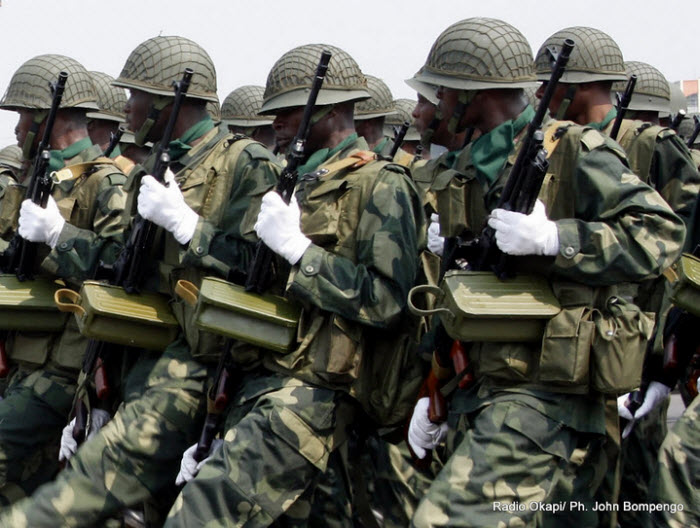
Armed Forces of the Democratic Republic of the Congo (FARDC)
Diversion likewise exacerbates security challenges. The Stockholm International Peace Research Institute (SIPRI) has found that FARDC units are involved in the diversion of arms to militias, while the lack of stockpile security further aggravates this problem.
In joining the ATT, the DRC would gain an opportunity to raise these and many other concerns over irresponsible transfers. Challenges resulting from the diversion of arms and ammunition could meaningfully be discussed with other states, including urging transit and transhipment states who are currently states parties to the ATT to comply with their ATT obligations.
Weapons exported to the DRC are used by both state and non-state groups to commit numerous human rights abuses. Persistent problems with accountability, stockpile security, and diversion of arms and ammunition will continue unabated if the DRC does not accede and robustly implement the ATT’s provisions. The Democratic Republic of Congo is long overdue to participate in international efforts to reduce the human suffering within its borders and beyond.

The post Why the Democratic Republic of Congo should join the ATT first appeared on Control Arms.
]]>The post Jamaican community activists leading the fight against cyclical armed violence first appeared on Control Arms.
]]>
Ansel Lee and his postcard at the third ATT Conference of States Parties in 2017.
“Jimmy Cliff’s “Wonderful world, beautiful people” is slowly becoming Bob Marley’s “Many more will have to suffer, many more will have to die” in Jamaica. The enveloping warmth of the ever-present sunshine, the breathtaking sunsets caressing the Caribbean sea and the vibrant music scenes are now shrouded by growing armed violence facilitated by small arms proliferation, drug trafficking and other criminal activities.
These are the words Ansel Lee, Jamaican activist and community organizer, wrote in a postcard delivered to over 300 delegates and governmental officials at the third ATT Conference of States Parties, held on 11-15 September 2017. Tragically, they still ring true one year later.
During the Third Review Conference of the UN Program of Action on small arms and light weapons (UNPoA) held on 18-29 June, I had the opportunity to speak with Ansel and his colleagues from the Kingston and St Andrew Action Forum (KSAAF). Bringing together local groups of community activists under the slogan “better communities, better Jamaica”, KSAAF works to combat armed violence in some of the most dangerous areas in Jamaica through social interventions including awareness raising, education and reintegration programs.
I was well aware that Jamaica, despite it’s beauty, rich culture and great music, has its fair share of challenges. But this meeting shone a light on an issue I had not fully considered – that of gun violence. Endemic particularly to communities with little resources and economic mobility such as West Kingston, gang violence and the availability of arms have been claiming lives for decades.
In many of these communities, possessing a gun means power, respect, and pride to its owner. There are little to no alternatives for acquiring status and economic stability. This is how young men, many close in age to myself, get drawn into a cycle of gang violence, involving drugs, arms and turf wars. The link between the drug and arms trade is clearly visible on the streets of West Kingston, most recently with arms flowing in from Haiti in exchange for Jamaican marijuana.

KSAAF members wearing orange to remember victims of gun violence on 22 June, 2018, at the UN headquarters in NYC.
To address this issue, the Jamaican government has implemented ‘Zones of Special Operations’, a program which aims to contain crime while safeguarding the human rights of residents and promoting community development. Through this programme, areas affected by high levels of armed violence are protected by military forces for short periods of time. Nevertheless, the gangs, well organized and highly skilled, are often able to cleverly avoid authorities while using “5 guns to commit 100 or more murders.”
The numbers are troubling. Police statistics show that guns were used to commit 90% of the murders recorded since the start of 2018. According to a working paper submitted by the Jamaica Permanent Mission to the UN before the UNPoA conference last month, 274 active gangs in Jamaica are believed to be involved in up to 80% of all major crimes. Many of these gangs operate transnationally, with networks supporting “small-scale smuggling operations with Jamaicans sending drugs to the U.S., Canada and the U.K., and importing arms mostly from the U.S. and Haiti.”

A member of the Jamaica Defence Force (JDF) walks with a toddler in the community of Denham Town in Western Kingston. Prime Minister, Hon. Andrew Holness on October 17, 2017 declared Denham Town the second Zone of Special Operations under the Law Reform (Zones of Special Operations) (Special Security and Community Development Measures) Act. Photo: Jamaica Information Service Photographer
Sustained efforts are being made, often to the detriment and safety of KSAAF members, to prevent and reduce these numbers. KSAAF, who regularly work in collaboration with government, adopt a hands-on approach in the battle against gun violence. This includes mediation between gangs and direct dialogue with gang members to de-escalate the risks of violence and disengage them from their gangs. KSAAF also offers a support system to former gang members, including social support, security and skills trainings/workshops to enable these individuals to provide for themselves through other means.
Another striking issue mentioned by the members of KSAAF is that well-established NGOs often arrive in Jamaica with pre-established agendas and top-down solutions, disregarding the needs and wants of the local organizations and communities. The programs and trainings they offer are frequently in skills and careers unappealing to the youth, creating little incentive for them to disengage from their gang associations.
Grassroots work such as that of KSAAF, alongside government policies like the Zones of Special Operations, can offer a long-term solution to Jamaica’s gun violence challenges. More attention and funding must be diverted to the efforts of organizations like KSAAF globally. Hearing the passionate stories of their honest and dangerous work was eye-opening and moving, and reminded me of similar situations of cyclical gang violence in other parts of the world including in places like Chicago, USA or Colima, Mexico.
The post Jamaican community activists leading the fight against cyclical armed violence first appeared on Control Arms.
]]>The post The kids have shown they are not afraid of the NRA, will the adults follow? first appeared on Control Arms.
]]>
 ‘This is what a tipping point looks like’ said the sign held up by a group of teens, along with ‘Watch out I can vote in 7 months’ and ‘Not Representing Americans’.
Attending the DC March for Our Lives on Saturday was an intensely moving and inspiring experience. As speaker after speaker, all of them children and young people spoke passionately and powerfully about the gun violence that has torn apart their lives, it was impossible not to be deeply impressed both by their courage in standing up in front of almost a million people and their conviction that change was possible.
Is it a tipping point? Maybe. There have been mass campaigns after previous horrific gun violence. After Sandy Hook, many around the world thought that now, surely, there would be changes to US gun laws. It was impossible to imagine that the senseless murder of 20 6-year-olds could not lead to change. But the NRA blocked and counter-campaigned, and any attempts to make even the slightest policy changes were ultimately thwarted.
The majority of Americans support background checks and limits on the ammunition capacity of weapons. That has not changed. What does feel a bit different is that this time, time, the NRA is the brand no one wants to be associated with. Corporate America has, for the first time, taken a principled – not profit-driven – stand against the NRA. Airlines, car rentals and banks dropped the NRA as special rate or discount partners and stopped selling certain rifles within their stores, while a football team chartered it’s plane to take students to the rally, and Lyft offered free rides to marchers. Veterans joined the marches, and a Veterans for Gun Reform video featured on the main screens.
This time, the NRA has suffered reputational damage. With its enormous budget of millions of dollars, and close association with the arms industry, the NRA has had seemingly limitless funds to put into opposing any and every form or arms control. And politicians both domestic and international have been afraid to challenge their power (indeed some politicians remain fearful of losing the NRA’s endorsement and continue to speak out against any and all gun control measures).
But fear is not in the hearts of the young people of Parkland, Chicago, New York, Newtown and many other cities represented in Saturday’s nation-wide rallies. These brave young people were not afraid to directly and unambiguously attack what they see as the nonsensical and self-serving policies of the NRA. They want action, they want change, and they’ve made it clear that they are not afraid to demand it – and, as many have pointed out, vote for it in the near future when they become of age.
Working in international arms control for the last two decades, I have seen the power of the NRA reach even into the halls of the United Nations, where the gun lobby groups come to campaign against the international community’s efforts to reduce armed violence and regulate the arms trade around the world. Some diplomats, even outside the US, have seemed fearful of their reach, and anxious to appease them.
Young people in American have shown they want change, and have turned out in large numbers to demand it. It is incredibly inspiring.
The question now is, are adults brave enough to respond to this call to action?
The post The kids have shown they are not afraid of the NRA, will the adults follow? first appeared on Control Arms.
]]>The post British weapons in Yemen: the human cost and the UK’s national interest first appeared on Control Arms.
]]>
Whatever good the UK might be doing on overseas aid or peacekeeping, the UK is severely undermining it on Yemen.
The level of destruction is eye-watering. With each indiscriminate Saudi airstrike using British weapons, UK complicity deepens. The grim daily reality is on average 13 new civilian casualties. Hospitals, schools and weddings destroyed. Over a million infected with Cholera and eight times that number on the brink of famine. UNICEF Yemen summed it up:
“There seems to be no hope”.
As a British citizen I am ashamed. How could Prime Minister Theresa May justify to a Yemeni whose life has been shattered, that this week she is playing host to the architect of much of this suffering: Saudi Crown Prince Mohammed bin Salman? That Britain is laying out the red carpet to help secure more trade with a country that an independent UN panel has accused of using the
“threat of starvation as an instrument of war”?
The UK’s irresponsible approach to arms exports is in sharp contrast to increasing numbers of our European neighbours. When you combine recent announcements from Norway, Germany and Finland to the existing policies of Netherlands and Sweden to restrict exports to those intervening in Yemen, the UK looks increasingly like one of the bad guys.
The Security Council has collectively failed Yemen but the UK must shoulder some of the responsibility. As a permanent (P5) member and as the Council lead on Yemen, questions should be asked as to why there has been so little action. Over three years of conflict there has been just one substantive resolution and a handful of presidential and press statements. While all parties to the conflict are at fault, it is the Saudis that escape any direct criticism. Can it be coincidence that it is their Crown Prince who is dining with the Queen at Buckingham Palace? With this lack of impartiality, it is hard to see how the UK can be effective in trying to broker an end to hostilities.

Is the UK’s policy to maintain at all costs its ‘strategic’ relationship with Saudi Arabia defendable? The opportunity cost of doing business with Mohammed bin Salman will turn out to be severe. To keep Raytheon’s Paveway IV bombs flowing from our shores, the Department of International Trade has had to trample over Article 7 of the Arms Trade Treaty, which states that transfers cannot take place if they could be used to commit serious violations of international humanitarian law. Any common-sense reading of the situation in Yemen clearly shows this threshold was met long ago.
Given that the UK considers the Arms Trade Treaty a key building block of the rules-based international system and believes that the preservation of this very system is vital to the UK’s future security and prosperity, the UK is only hurting itself in the long run.
International rules and institutions including the UN are only as strong as the political will invested in them. The international system that has insulated the West from conflict for 73 years is fraying. By cherry-picking its favourite bits of multilateralism and ignoring others, the UK is contributing to the problem.
For all the chaos, Brexit is forcing a long-overdue debate on Britain’s role in the world to the fore. My vote is for a global Britain which places human rights and the protection of civilians above short-term business interests. For a country that embraces international cooperation as our best hope to secure our future. For a Britain with a sense of global solidarity.
By throwing the rule-book out of the window when it comes to Saudi Arabia, the UK strikes two blows, one to the credibility of the international system, and another to its own national interest.
The post British weapons in Yemen: the human cost and the UK’s national interest first appeared on Control Arms.
]]>


For nearly two and half years now, civilians in Yemen have been subjected to a near-daily barrage of bombing. Our schools, hospitals, homes and markets have been targets. Even weddings and funerals have been deliberately bombed. As a Yemeni, I have seen this with my own eyes. I have watched my country descend into flames, and have despaired as we now move closer and closer to famine. The devastation of crucial water supplies has led to a cholera outbreak – a disease long eradicated from our country. The destruction of medical infrastructure has left us with close to nothing to stop this deadly disease.
What we desperately need from the international community is humanitarian assistance, support for a peace process, and a push for accountability. Instead, we get more and more bombs.
On Monday, 10 July, the UK High Court issued a ruling in support of the British Government, and against NGO Campaign Against Arms Trade, which had mounted a legal challenge to try to stop the arms supplies to Saudi Arabia. In an utterly mystifying ruling, the High Court determined that the UK government is within its rights to decide, without challenge, whether to allow these arms supplies to continue.
Our lives seemed not to factor into this ruling.
Bombs keep falling on our homes and hospitals. Our daily suffering will continue unimpeded if governments, like the UK, keep providing arms is support to the Saudi-led coalition. For years governments have resisted independent international inquiry into the conflict. This must change, as soon as possible.
CAAT have told us they plan to appeal against the ruling. We welcome this, and the efforts of all NGOs who continue to campaign against the supply of bombs and other weapons used against innocent Yemeni civilians. Their humanity is some comfort to us. Please join them in asking all governments to stop the supply of deadly weapons to all warring parties in Yemen – our very lives depend on it.
The post Judging Against Our Lives first appeared on Control Arms.
]]> Four years ago the Arms Trade Treaty opened for signature in New York. Almost 70 world leaders were in the audience, eager to be among the first to sign the ATT. It was a celebratory day, full of ambitious statements of what this new Treaty, the first to regulate the global trade in conventional arms, and with central criteria around international human rights and humanitarian law, would achieve in reducing human suffering around the world.
But will those lofty words ever be realized? Four years on, some of the governments which were at the forefront of working with civil society to achieve the Treaty are among its worse violators. The excitement of chasing the goal of a Treaty, a new legal framework, has morphed into the dull reality of tedious UN meetings discussing rules of procedure and financial arrangements.
Last week in Geneva, in four days of meetings to prepare for this year’s ‘Conference of States Parties, governments spoke not of arms transfers that were in violation of the Treaty, but of standing meetings, payment schedules and reporting templates. All are important infrastructure elements that need to be in place, but not at the expense of discussing actual arms transfers that are leading to civilian deaths and humanitarian crises.
Control Arms, raising the issue of arms sales to Saudi Arabia in the context of the devastating humanitarian crisis in Yemen, a people facing a daily barrage of aerial bombardment, were even reminded by the chair not to ‘repeat points already made’. Governments, it seems, are tired of civil society reminding them of their legal obligations. But perhaps a better way to manage NGOs persistent points would be to engage with them, and discuss ways to prevent such violations persisting.
The US, a signatory to the ATT, recently announced its intent to proceed with an arms deal to Saudi Arabia worth over $100 billion in its first year, a deal of staggering proportions, equivalent to the entirety of the rest of the current global arms trade. States Parties, including the UK and France, continue with arms transfers to Saudi also, despite the overwhelming evidence that that such weapons will almost certainly be used against civilian targets in Yemen, and therefore authorizes contrary to Articles 6 and 7 of the ATT. This situation is surely worthy of States Party’s time to examine and discuss.
While Yemen stands out as one of the most egregious violations of the Treaty, it is not the only case. From South Sudan to Syria, arms flows continue to fuel conflicts and human rights abuses.
The Arms Trade Treaty remains a relatively new Treaty in the international scene. Progress has been made – it is positive that there are more than 90 ATT States Parties now, and that many have put in place national control lists, the first step in ensuring Treaty implementation. Others have made their arms exports public for the first time, and some have reported stopping arms transfers in the face of evidence of likely human rights abuses.
But there is still much more that governments need to do to properly implement the provisions they are now legally obligated to. For the civilians of Yemen, there is not that luxury of time. It is time for government to revisit those speeches and ambitions of four years ago, and to take action.
Written by Anna Macdonald
The post Four Years On, It’s Time For Action first appeared on Control Arms.
]]>