Next week, UN Member States and other stakeholders will convene in Geneva, Switzerland for the Eleventh Conference of States Parties (CSP11) to the Arms Trade Treaty (ATT). Scheduled for 25–29 August, CSP11 comes at a time when responsible arms regulation is essential to protect the 2 billion people living in a conflict zone.
The conference provides an opportunity to take stock of achievements and challenges to date and to develop strategies for the future. In this context, ATT States Parties will assess progress in implementing the Treaty, share challenges, and consider new measures to strengthen the ATT’s long-term impact. In practice, this means reviewing recommendations from the ATT Working Groups, adopting decisions on substantive proposals, and setting the course for the Treaty’s future direction.
Against a backdrop of intensifying armed conflicts and deepening humanitarian crises – from the devastating conflicts in Gaza, Myanmar, and Sudan to protracted violence in Yemen, Ukraine and the Democratic Republic of Congo (DRC) – this meeting is a chance for States to demonstrate renewed commitment to the ATT’s humanitarian objective: to stop irresponsible arms transfers and reduce human suffering. The decisions made at CSP11 will not only impact the Treaty implementation and credibility, but can potentially carry real consequences for individuals and communities affected by conflict and armed violence.

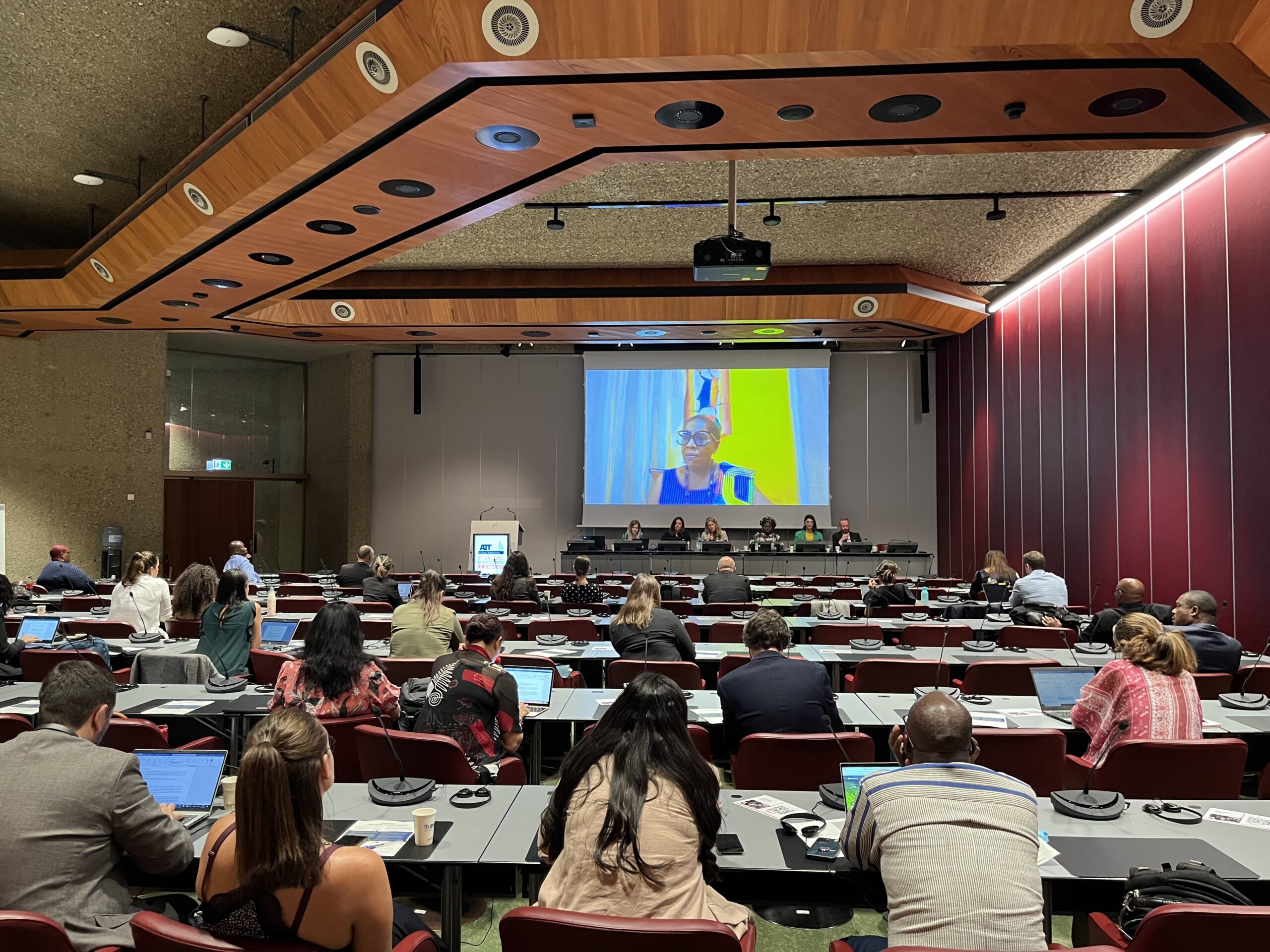
Delegates attending the second Conference of States Parties to the Arms Trade Treaty in August 2016 in Geneva, Switzerland.
CSP11: What are the key issues on the table next week?
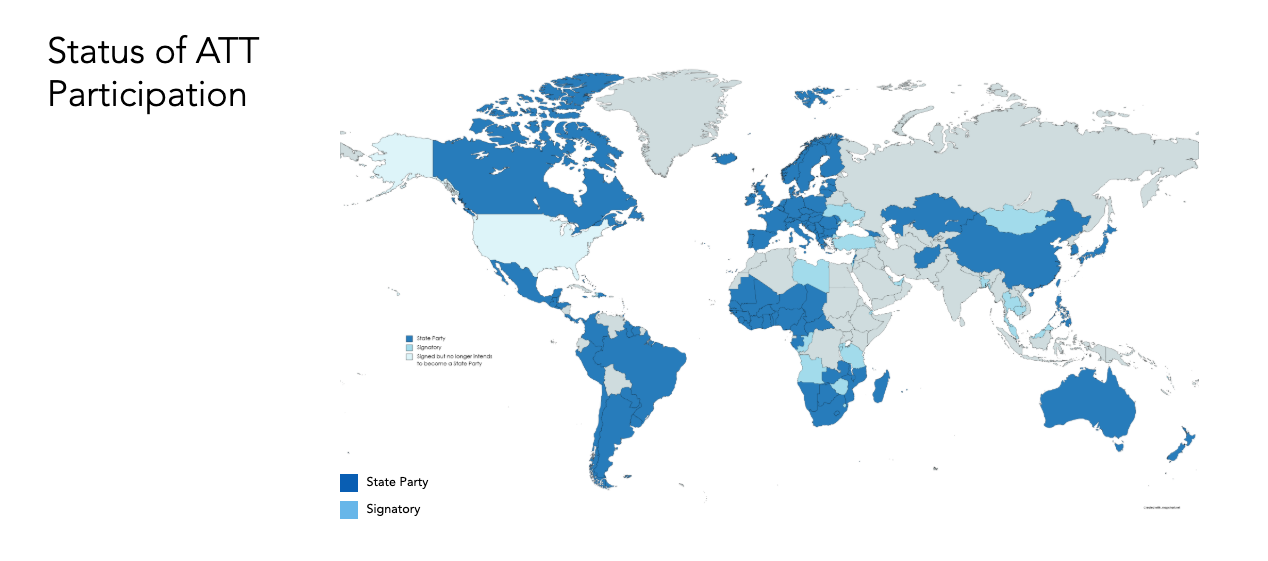
The President of CSP11 (Ambassador Carlos Foradori of Argentina) has made “Universalization as a Priority” the thematic focus of this conference. While 116 States have now ratified the Treaty, ATT membership remains uneven, particularly in the Asia Pacific and Middle East regions. To address universalization gaps, the President’s working paper puts forward a set of recommendations including encouraging States Parties (and the ATT Secretariat) to integrate ATT universalization into bilateral and regional meetings, to share best practices with signatories and other non-state parties, and to strengthen the strategic partnership with the Inter-Parliamentary Union. It also recommends a stronger emphasis on public outreach – launching awareness campaigns that highlight the ATT’s humanitarian impact, promoting engagement with other stakeholders including industry, academia, media, and civil society; encouraging participation of youth in the ATT and identifying Goodwill Ambassadors or Champions for the ATT.
CSP11’s agenda will then focus on the work of the ATT Working Groups and the recommendations they put forward for endorsement:
- The Working Group on Treaty Universalization (WGTU) underscored the urgency of expanding ATT membership, stressing that universal participation is critical to closing persistent gaps in the global arms trade. The Co-Chairs recommended that States Parties assume the role of regional universalization champions and systematically include other regional universalization champions, regional organizations, and other regional actors in their outreach efforts. They also encourage States to share experiences by presenting on their own processes for ratification, accession, and domestication, offering practical guidance to non-States Parties.

Mwachofi Singo, Deputy Director of Security Research and Information Centre (SRIC) in Kenya, delivering a statement on behalf of the Control Arms delegation under the WGETI agenda item at the Third Conference of States Parties to the ATT.
2. The Working Group on Effective Treaty Implementation (WGETI) completed the first year of its new Sub-working Group on Exchange of National Implementation Practices and its multi-year workplan, with discussions centered on practical aspects of ATT implementation. Discussions covered the role of industry in applying human rights and IHL due diligence, the risk of conventional arms being used for gender-based violence (GBV) and violence against women and children, and proposals for ad hoc discussions on current conflicts and relevant international rulings. Building on these exchanges, WGETI recommends continuing structured discussions on national practices such as import systems, control lists, and brokering, while also tackling challenges related to parts, components, and emerging technologies. WGETI further proposes continuing discussions on the development of voluntary guidance to
link industry due diligence with States Parties’ responsibilities under the ATT and to encourage the engagement of industry actors in ATT discussions. A central recommendation is the draft decision to establish Gender Focal Points (GFPs), voluntary positions that would help States mainstream gender considerations, strengthen GBV risk assessments, and promote the participation of women in ATT implementation. Another key decision which can impact the credibility of the ATT as a forum is related to the continuation of ad-hoc discussions on topics raised by States Parties and other stakeholders.
3. The Working Group on Transparency and Reporting (WGTR) emphasized the need to improve compliance with reporting obligations, noting that only around 60% of States Parties are currently submitting timely and complete reports. The WGTR recommended that States Parties submit all outstanding reports to the ATT Secretariat or seek assistance in this regard. States that have adopted new ATT implementation measures since submitting their initial reports are urged to provide updated reports, and the Secretariat is encouraged to make these updates more visible on its website. The WGTR also invited States and other stakeholders to give presentations at the next meeting on the theme of “Reports to Cabinet and/or Parliament.” In addition, States were encouraged to act as “reporting champions” and submit specific assistance offers to the Matching Database. Finally, the WGTR requested that a future session hold an in‑depth discussion on sources and methodologies for data collection, as well as decision-making on substantive reporting issues.
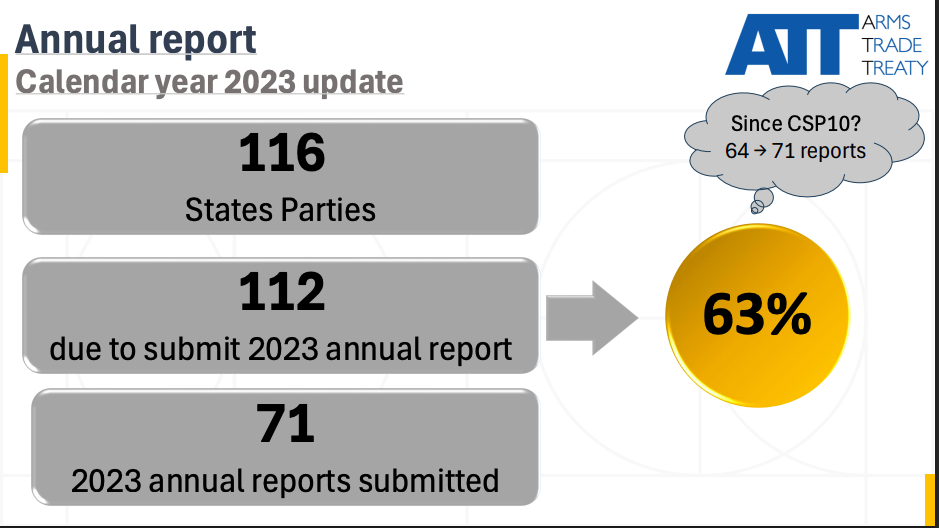
Slide from presentation on “Arms Trade Treaty Status of Reporting” provided by Tom NIJS of the ATT Secretariat during the February 2025 meeting of WGTR.

CSP11’s agenda will also include consideration of a proposal from the United Kingdom to agree on a mandate to elaborate a five-year strategy for the Arms Trade Treaty by CSP12. Currently, the ATT lacks a comprehensive multi-year strategy, resulting in ad-hoc progress and inconsistent focus from year to year. The proposal calls for the ATT Secretariat to collect inputs from States Parties and stakeholders on objectives and benchmarks, and with support from the “ATT Bureau” (comprising the President, Vice-Presidents, committee chairs, and others) to compile a draft strategy by 2026. The strategic roadmap would set clear goals and performance indicators to measure progress against priorities, to identify key opportunities and challenges facing the Treaty, assess available and needed resources, and provide guidance for prioritizing future activities.
4. CSP11 will also consider the findings of the Management Committee’s review of the revised ATT Programme of Work, tested over the past year. The revised format, which introduced one four-day Working Group session and one two-day Informal Preparatory Meeting held separately, was found to improve the quality of discussions and better prepared delegations for the Conference itself. Based on this, the Management Committee recommends continuing with the revised format. The Committee also included recommendations to improve cost-effectiveness and participation, including exploring remote interpretation, using smaller venues, strengthening the circulation of documents in advance, and aligning future thematic priorities with Working Group agendas. The next review will be conducted at CSP13.
Broader Implications and Expectations
The Arms Trade Treaty was adopted to reduce human suffering caused by illicit and irresponsible arms transfers. The conflicts in Gaza, Yemen, Myanmar, Ukraine, Sudan and the Democratic Republic of Congo illustrate the devastating consequences of poorly regulated conventional arms transfers and underscore that the Treaty’s humanitarian objectives remain as urgent as ever.
The agenda before the CSP11 includes important steps to improve the Treaty’s functioning – from strengthening reporting and transparency, to advancing universalization, to agreeing on a five-year strategy. These are valuable initiatives, but they are largely procedural.

What is missing is an open and substantive discussion about how States are applying the Treaty’s provisions in their transfer decisions. Are States rigorously assessing the risks that exported arms could be used to commit violations of international humanitarian or human rights law? And if they are, on what basis are they approving arms transfers to states that are parties to ongoing conflicts? How are they evaluating diversion risks? And crucially, how are these decisions shaping the reality for civilians living under fire?
As the ATT enters its second decade, CSP11 offers a critical opportunity for States Parties to move beyond process and focus on impact. Ensuring compliance with the Treaty’s core obligations – to assess the risk of conventional arms transfer – is the only way to ensure that the ATT delivers on its promise: to reduce human suffering caused by conflict and armed violence.
The post Advancing ATT Implementation: Key Issues and Expectations for CSP11 first appeared on Control Arms.
]]>The post Marking 10 Years Of The ATT: Successes And Challenges first appeared on Control Arms.
]]>Progress and challenges
Reflecting on a Decade of the Arms Trade Treaty
24 December2024 marks a decade since the ATT entered into force—a milestone in global efforts to bring transparency and accountability to the conventional arms trade.
On December 24, 2024, we will commemorate the 10th anniversary of the Arms Trade Treaty (ATT), a groundbreaking legal instrument that established international standards for regulating conventional arms transfers with the explicit goal of reducing human suffering. This historic milestone is a testament to the tireless efforts of campaigners, governments, and civil society to bring transparency and accountability to the global arms trade. Over the past decade, the ATT has made significant strides, yet it continues to face challenges that require renewed commitment from the international community.
Achievements Over the Decade
Since its entry into force, the ATT has seen significant progress in universalization and implementation.
With 116 States Parties and 26 signatories, the Treaty has gained broad support across all regions of the world. ATT States Parties have undertaken measures to align their national legislation with the Treaty’s provisions, enhancing the regulation of international arms transfers and promoting transparency. For example, some ATT States Parties have established comprehensive national control systems regulating the export, import, transit, and brokering of conventional arms, in compliance with Treaty obligations. Others have implemented export control laws and designated competent national authorities to oversee arms transfers. Additionally, States Parties have adopted national control lists, established mechanisms for end-user certification to prevent the diversion of arms, and strengthened their arms export licensing processes to include comprehensive risk assessments.
These efforts exemplify the ATT community’s commitment to responsible arms trade and the effective implementation of the Treaty’s provisions.

Ongoing Challenges
Despite the Arms Trade Treaty (ATT) establishing international standards to regulate arms transfers and reduce human suffering, significant challenges persist. A considerable number of major arms-producing states remain outside the treaty. Reporting compliance has been inconsistent, and some ATT States Parties have not fully adhered to its provisions, undermining its effectiveness. Over the past decade, weapons and munitions have continued to flow into brutal armed conflicts and situations of repression. Notably, some ATT States Parties have approved arms transfers into contexts where serious violations of international law have been documented, including Myanmar, the Occupied Palestinian Territories, Sudan, and Yemen.
Control Arms calls for all States Parties to fully adhere to the ATT’s provisions and for the international community to strengthen mechanisms ensuring compliance, thereby upholding the Treaty’s fundamental goal of reducing human suffering.
Looking Forward
As we enter the second decade of the ATT, it is crucial to address these challenges. Enhancing transparency, strengthening accountability mechanisms, and encouraging universalization of the ATT are essential steps toward realizing the treaty’s full potential. The international community must renew its commitment to the ATT’s objectives to ensure it effectively contributes to reducing human suffering and promoting global peace and security.
On this milestone, Control Arms reaffirms its commitment to advocating for robust implementation of the ATT and calls on all States to intensify their efforts to uphold the ATT’s object and purpose: to reduce human suffering. It also urges states to join the Treaty if they have not yet done so, and to ensure its robust and meaningful implementation. By working together, we can continue to transform the global arms trade and make the vision of the ATT a reality: a safer world with less human suffering.
As we reflect on a decade of progress, we look forward to building on prior achievements and addressing ongoing challenges in the years to come.

Other Resources

Warpod: Ten years of the Arms Trade Treaty
Saferworld
🎙️ Reflect on a decade of the Arms Trade Treaty with Saferworld’s latest Warpod episode. Join experts Roy Isbister and Elizabeth Kirkham as they discuss the ATT’s successes, challenges, and future prospects.

Reflections on the Arms Trade Treaty at 10
Rachel Stohl, Stimson
Discover key insights into the successes, challenges, and future priorities of the Arms Trade Treaty as it marks its 10th anniversary in this reflective piece by the Stimson Center
ATT Milestones
Key Arms Trade Treaty Milestones in the last decade.
2013
Adoption of the Arms Trade Treaty
On 2 April 2013, the Arms Trade Treaty was adopted by a vote of 154 in favour, 3 against, and 23 abstentions. It opened for signature on June 3rd, 2013! This marked a historic step towards regulating the international arms trade.
On 3 June 2013, the ATT opened for signatures. Sixty-seven countries sign the treaty on the opening day.

2014

Entry into Force
On 24 September 2014, only a year and a half after it opened for signatures, the ATT reached the 50 required ratifications and triggered the treaty’s entry into force, thus becoming the fastest growing UN treaty.
2015
First Conference of States Parties and Entry into Force
On 24 – 27 August 2015, the First Conference of States Parties (CSP1) was held in Cancun, Mexico and was presided over by Ambassador Jorge Lomónaco of Mexico.
On24 December 2015, the Arms Trade Treaty entered into force with 61 ratifications and 130 signatures.

2019

100 States Parties
On 14 December 2019, The Treaty reaches 100 States Parties, following Mozambique’s ratification.
2024
10th Conference of States Parties
On 19 – 23 August 2024, the Tenth Conference of States Parties (CSP10) of the Arms Trade Treaty (ATT) was held in Geneva, Switzerland and was presided over by Ambassador Razvan Rusu of Romania.

The post Marking 10 Years Of The ATT: Successes And Challenges first appeared on Control Arms.
]]>Latin American Regional Workshop: Increasing effective implementation of the Arms Trade Treaty through practical understanding of gender-based violence and violence against children criteria
6-8 February 2024 – Ministry of Foreign Affairs, Mexico City
The overall goal of the project was to provide accessible guidance to licensing officials and civil society on how to conduct GBV risk assessments consistent with the commitments set out in the ATT. Although originally planned as a workshop focused solely on the relationship of GBV and ATT risk assessment, Control Arms’ How to Use the Arms Trade Treaty to Address Violence Against Children: A practical guide for risk assessment was also incorporated as part of the curriculum and discussions given the incidence of firearms on violence against adolescents and the role of arms in the recruitment of children in the Latin American region.
The regional workshop included participants from six Latin American countries, which are at different stages of implementing the Treaty or seeking to accede to it. Participants included government officials from Argentina, Brazil, Chile, Colombia, Mexico and Panama. To facilitate exchanges on best practices and effectively address challenges in identifying and documenting cases of GBV and violence against children (VAC), a diverse group of stakeholders (including civil society) was convened along with experts from the International Committee of the Red Cross (ICRC), UNICEF, and the Center of Excellence-UNODC.
Through hypothetical and interactive exercises as well as group discussions, participants applied the lessons learned during the training, shared national perspectives, best practices and challenges.
This project was made possible with financial assistance from the UN Trust Facility Supporting Cooperation on Arms Regulation (UNSCAR) and with support from the Mexican Ministry of Foreign Affairs.
Course Pack and Agenda
Final Summary Report

The post ATT GBV Training Mexico first appeared on Control Arms.
]]>